
Unser Dezimalsystem ist kein blinder Griff des menschlichen Verstandes. Es ist sicher als der richtigste Prototyp überall in der Natur nachgebildet.
Our decimal system is not some blind grasping of the human understanding. It is assuredly replicated as the most correct prototype anywhere in nature.
—Eschenmeyer, Grundriss der Naturphilosophie §93
Carl August Eschenmeyer (1768–1852) is one of the more peculiar satellites of the Naturphilosophie tradition. A physician by training, he moved progressively from rigorous Kantian critique toward speculative natural philosophy and, in his later years, toward a Christian mysticism that put him at odds with Schelling, despite Schelling having dedicated his dialogue Bruno to him in 1802. His Grundriss der Naturphilosophie (1832) is a late summation, attempting to organise the whole of natural science under a triadic schema derived simultaneously from logic and arithmetic.
The passage below, §93, is representative of his method. Where Oken derives the sphere from the primordial acts of the Absolute, Eschenmeyer derives it from the structure of the decimal number system, showing that the arithmetical and the cosmological are secretly the same schema, read from different ends. The “Nature-Schema” he describes is a 3×3 grid of orders and dimensions (general, particular, singular) with 0 as the indifference-point of the whole. Five—the midpoint of the nine non-zero digits—falls on the intersection of the indifference line, the axis that divides positive from negative within the numerical cosmos.
§93
Our decimal system is not some blind grasping of the human understanding. It is assuredly replicated as the most correct prototype anywhere in nature.
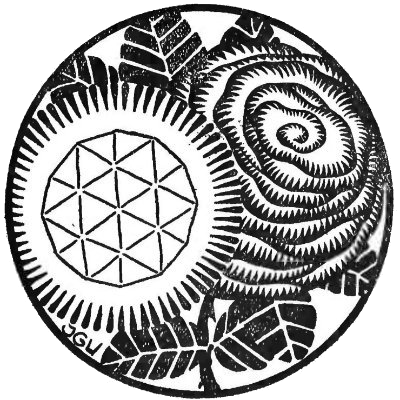
Ten digits: $1,2,3,4,5,6,7,8,9$ contain the initial unity and all the rest are only repetitions of it in higher orders. Apart from $0$, as indifference, we have $9$ simple digits and this number is just as we have demonstrated in the threefold triplicity of the ideas and their dimensions—the basic number of nature—which is also replicated by the sun itself.
If we want to translate the decimal system into the orders and dimensions of the Nature-Schema, as it is set forth in the cosmogony, then it will take the following form, setting the order $= O$ and the dimensions of the general $= A$; the particular $= B$ and the singular $= E$.
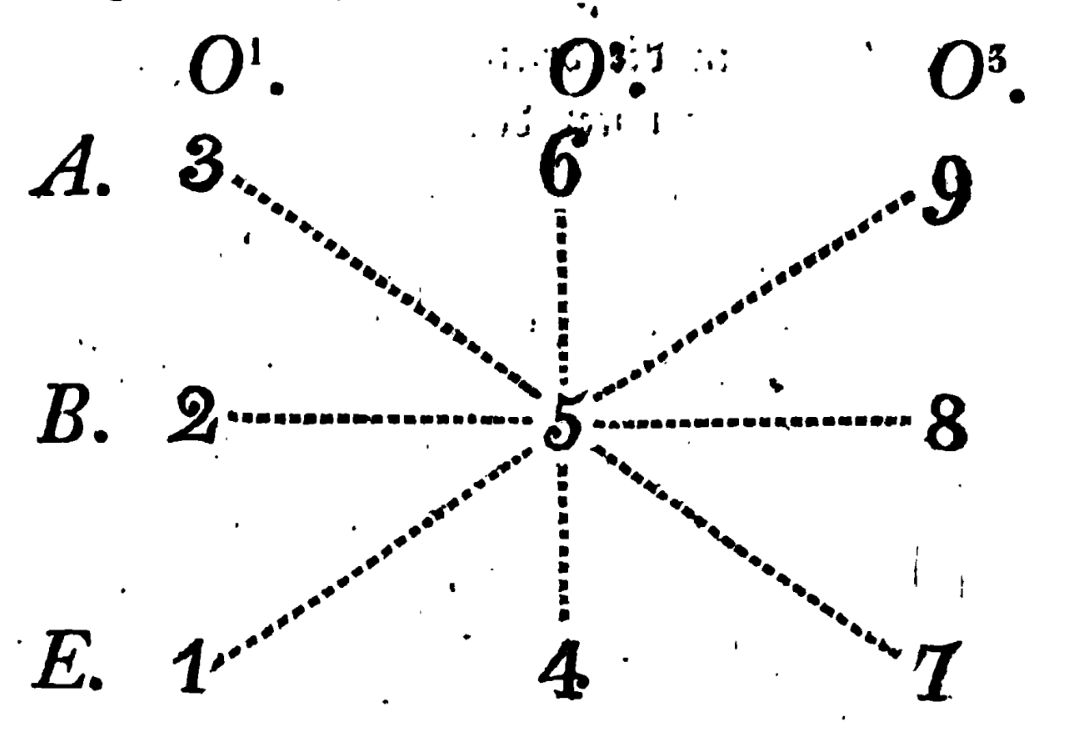
In this figure there are four dotted lines: two diagonal lines, one perpendicular and one horizontal. One diagonal line goes from the lowest dimension of the first order to the highest dimension of the third order and thus unites the extremes of the series; this is called the difference line. The second diagonal line goes from the highest dimension of the first order to the lowest dimension of the third order and holds the whole second order with its dimensions between its endpoints. Since we have to assume that the shared midpoint of the 4 lines, which falls on the number 5, is at the same time the indifference point of all values, and that therefore what falls above the indifference point is positive and what falls below it is negative, the second diagonal is that line which separates everything positive from the negative; it is therefore called the indifference line.
The perpendicular line passing through the dimensions and the centre is called the dimension line, and the horizontal line passing through the centre and the orders is called the order line.
§93
Unser Dezimalsystem ist kein blinder Griff des menschlichen Verstandes. Es ist sicher als der richtigste Prototyp überall in der Natur nachgebildet.
Zehn Ziffern: $1,2,3,4,5,6,7,8,9$ enthalten die erste Einheit und alles Übrige sind nur Wiederholungen derselben in höhern Ordnungen. Ausser der $0$ als Indifferenz haben wir $9$ einfache Ziffern und diese Zahl ist eben so, wie wir sie in der dreifachen Triplizität der Ideen und ihrer Dimensionen nachgewiesen haben, die Grundzahl der Natur, welche auch die Sonne in sich nachbildet.
Wollen wir das Dezimalsystem in die Ordnungen und Dimensionen des Natur-Schema, wie es in der Kosmogonie dargelegt ist, übertragen, so wird es, die Ordnung $= O$, die Dimensionen nehmlich der Allgemeinheit $= A$; der Besonderheit $= B$ und der Einzelheit $= E$ gesetzt, folgende Form annehmen.
In dieser Figur sind vier punktirte Linien, zwei Diagonale Linien, eine perpendikuläre und eine horizontale. Eine Diagonale geht von der niedersten Dimension der ersten Ordnung bis zur höchsten Dimension der dritten Ordnung und vereinigt somit die Extreme der Reihe, sie heisse die Differenz-Linie; die zweite Diagonale geht von der höchsten Dimension der ersten Ordnung zur niedersten Dimension der dritten Ordnung und hält die ganze zweite Ordnung mit ihren Dimensionen zwischen ihren Endpunkten. Da wir annehmen müssen, dass der gemeinschaftliche Durchschnittspunkt der 4 Linien, welcher auf die Zahl 5 fällt, zugleich der Indifferenzpunkt aller Werthe ist, und dass mithin das, was über den Indifferenzpunkt fällt, positiv, was unter ihm liegt, negativ ist, so ist die zweite Diagonale diejenige Linie, welche alles Positive von dem Negativen scheidet, sie heisse daher Indifferenz-Linie.
Die perpendikuläre Linie, welche durch die Dimensionen und den Mittelpunkt geht, heisse die Dimensionen-Linie, und die horizontale Linie, welche durch den Mittelpunkt und die Ordnungen geht, heisse die Ordnungs-Linie.
From: Eschenmeyer, Carl August, Grundriss der Naturphilosophie (Tübingen: Osiander, 1832), §93.