
The so-called unity of the group is a function of nothingness. Zero becomes the unity of everything.
—Nishida Kitarō, Diaries (upon revisiting Parmenides, Cusanus, and Duns Scotus)
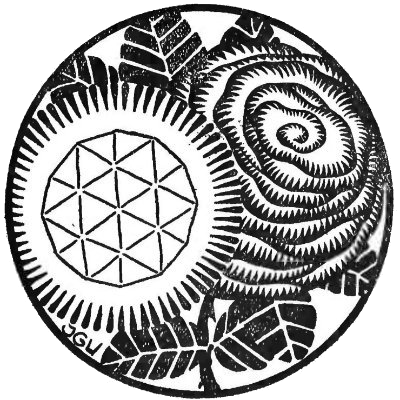
The connection begins with Parmenides. In Fragment 8, Being is described as “παντόθεν εὐκύκλου σφαίρης ἐναλίγκιον ὄγκῳ / μεσσόθεν ἰσοπαλὲς πάντῃ” — like the mass of a well-rounded sphere, equal every way from the centre. Being, for Parmenides, does not merely resemble the sphere; the sphere is its disclosure. Undivided, uniform, without inside or outside, it has no privileged direction and no exterior from which it could be grasped. The sphere is what Being looks like when you remove all determination.
This is the image that Nishida Kitarō’s logic of basho (場所 — place, topos) inherits and transforms. For Nishida, a thing is always already in a place; the place is itself in a further place; until we reach the basho no basho — the place of place — which is absolute nothingness (絶対無). “That which relates physical space to physical space is no longer physical space, and there must further be a basho wherein the physical space is implaced.” This final enveloper cannot itself be placed. It is the Parmenidean sphere at the limit of the series of envelopments: the sphere that contains all spheres without being contained by any, the topos that has no outside.
The key term is envelopment. Nishida insists that his absolute nothingness is not a reversal of Platonism but an envelopment: “In the place (場所) of cognition, which envelops pure acts within it, all phenomena must possess directionality.” The absolute does not negate the relative; it holds it, wraps it, precedes it as the condition that cannot be converted into one of its own conditioned terms.
The precise apparatus of Nishida’s encompassing language does more structural work than a casual reading reveals. The fundamental relation is ni oite aru (に於てある — “is located in”): everything that is, is “located in” a basho; the basho is that which encompasses, and its content is that which is located. Nishida’s vocabulary then bifurcates according to logical level. At the level of the abstract universal (抽象的一般者) — the formal level of genus-species inclusion — he uses hōsetsu suru (包摂する — to subsume) and hōsetsu (包摂 — subsumption): the vocabulary of formal containment. But at the level of the concrete universal (具体的一般者), where the logic of basho properly begins, the vocabulary changes entirely: fukumu (含む — to contain), tsutsumu (包む — to wrap/encompass), naihō suru (内包する), hōyō-men (包容面 — encompassing plane), hōetsu-sha (包越者 — encompassing transcendence). The distinction marks a difference in kind: subsumption belongs to formal logic; encompassing belongs to the logic of basho.1 This is precisely the difference — in the Romantic tradition — between the merely recursive self-reference of a concept referring to itself, and genuine Potenzierung: the raising to a higher power that generates a new ontological level rather than merely redescribing the same one.
The hierarchy that results is a series of concentric encompassing structures, each basho containing the previous as its content. The individual (個物) is located in the basho of being; the conscious self (意識的自己) in the basho of relative nothingness; the intelligible self (叡智的自己) in the basho of absolute nothingness — the most encompassing universal, which cannot be determined by anything yet wider, and in whose self-determination everything consists. Each level of encompassing involves a triad of determinations: gentei (限定 — determination), jiko gentei (自己限定 — self-determination), and sōgo gentei (相互限定 — mutual determination). The encompassing and the encompassed are not static; they determine one another in a relation that modifies both. And this movement of mutual determination passes through jiko hitei (自己否定 — self-negation): the encompassing basho negates itself in the act of encompassing, and what is located within it acquires new status precisely through that negation. Absolute nothingness is not the privation of being but the maximally productive self-negation — that which spares nothing, including nothingness itself.
Schlegel and Novalis are working with the same logic. A very common device in their writing is what one might call the metagenitive: a singular term that possesses its own plural — “Idea is the concept of concepts,” “Image is the appearance of appearances.” Schlegel makes the structural point explicit in Athenäum Fragment 238: transcendental poetry should “always be simultaneously poetry and the poetry of poetry.” This is not merely self-reference; it is a claim about level. Each iteration produces a term that envelops the one below. The transcendental is, precisely, the enveloping register: “whatever relates to the joining or separating of the ideal and the real.”
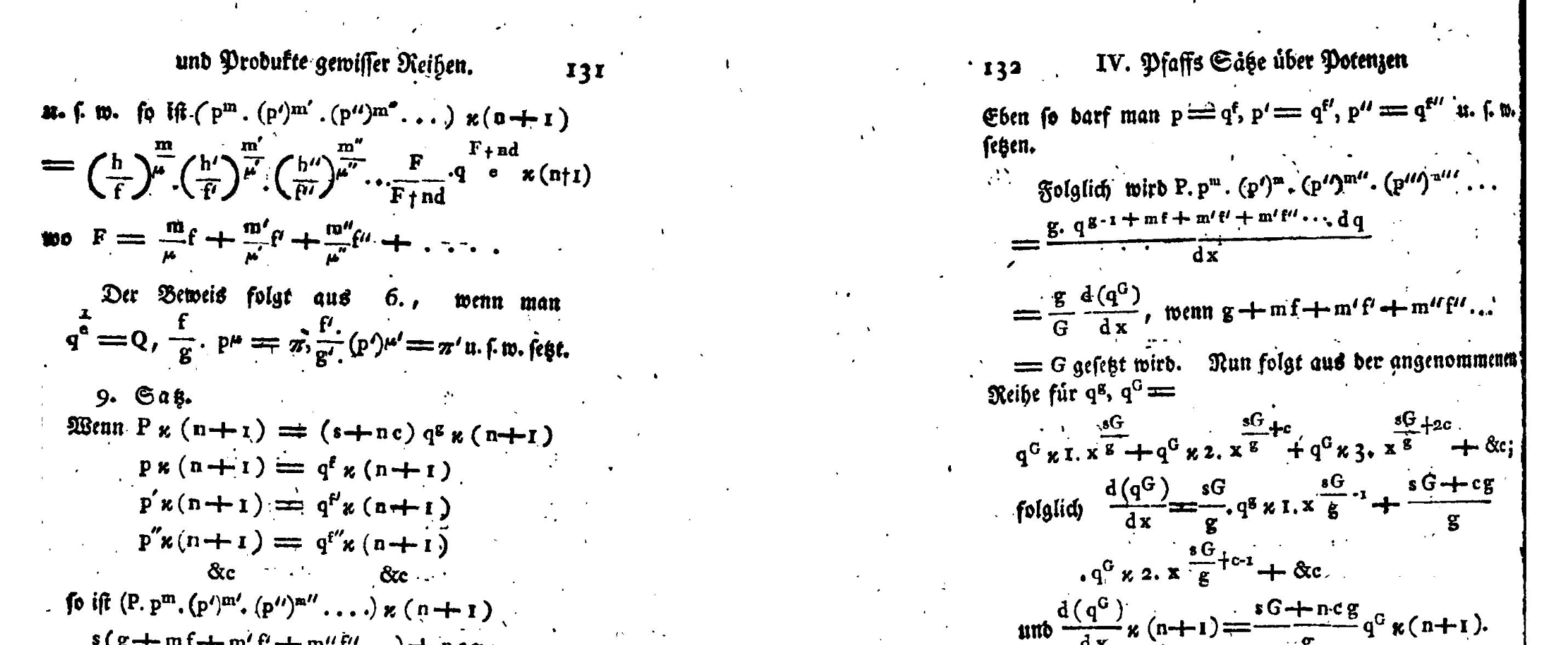
Novalis names the operation Potenzierung — potentiation, raising to a higher power. Schlegel: “Das Potenziren des Objekts hält Schritt mit den Stufen der Reflexion im Subjekt” (the potentiation of the object corresponds to the levels of reflection in the subject). Novalis: “Der Geist ist das potenzirende Princip” (Spirit is the potentiating principle). Schlegel’s Transzendentalpoesie is, in his own formulation, “eine ins Unendliche potenzierte Poesie” — poetry raised to infinity. And potentiation, crucially, is “a combination with oneself”: it stands for self-determination, for the possibility of raising oneself to ever higher powers in an infinite series of self-encounters. What you arrive at, at the limit, is the sphere — the figure of pure self-enclosure, the form that results when a line is rotated through all dimensions simultaneously.
Mahnke’s genealogy of geometric mysticism shows that for Novalis (Hardenberg), the Muttersphäre appears precisely as this limit: the “shared sphere of object and subject,” the absolute sphere without limit that envelops all the bounded relative spheres of empirical egos “as the infinite sphere encompasses all finite spheres.” Unlike Fichte’s absolute I, it is not a positing act but a ground — what Novalis, revealingly, prefers to call “God in the right sense.” Astralis in Ofterdingen gives it a voice: “Ich bin der Mittelpunkt, der heilge Quell, / Aus welchem jede Sehnsucht stürmisch fließt” (I am the centre-point, the holy spring, / From which all longing flows in storm).
As Tremblay observes, “Nishida’s notion of temporality possesses the character of ’encompassing,’ just like the logic of basho.”2 The encompassing structure is not confined to the ontological hierarchy; it extends into Nishida’s account of time in exactly the same way. Just as everything that is is located in a basho, everything real is located in time; time is located in the present (jōshoteki genzai, 場所的現在 — the present-as-basho); the present is located in the self; and the self is located in the eternal now (永遠の今). “The self does not exist in time, it is time that exists in the self.” The self functions as the hypokeimenon of time — its substrate, the place wherein the temporal flow takes place — and the eternal now ultimately coincides with absolute nothingness. The two series, ontological and temporal, arrive at the same limit: the basho that encompasses all basho without itself being encompassed.
This nesting structure — souls expressing the world-soul, each level both containing and being contained by the next — finds an unexpected analogue in Schelling’s Weltalter (Ages of the World, 1811–1815). In that work, Schelling’s organicist account of time operates through the tension between natura naturans (naturing nature, the productive ground) and natura naturata (natured nature, the produced totality), a tension embedded within what he calls the global Weltseele, the world-soul. Individual souls are not separate from this whole but expressions of it — each one a microcosm of the cosmic encompassing, each containing the same natura naturans/naturata polarity at a smaller scale. The nesting is not merely metaphorical: for Schelling, the productive self-determination of the Absolute is replicated at each level of natural organisation, so that every organic form recapitulates the logic of the whole within which it is located. This is structurally identical to Nishida’s self-determination of basho within basho — the logic of jiko gentei (self-determination) and sōgo gentei (mutual determination) operating at every level of a nested series.
At the geometric limit, Nishida himself reaches for the same figure Mahnke traces through the history of mystical mathematics. Absolute nothingness, he writes, “is like an infinite circle whose center is everywhere, and whose circumference nowhere.”3 The formula is recognisably Pascalian — and, behind Pascal, Cusan: the coincidentia oppositorum rendered as a sphere that has no outside because every point is equally central. Mahnke tracked this formula from Plotinus through Eriugena, Nicholas of Cusa, and Leibniz to the German Romantics. Nishida arrives at it independently, via the logic of basho and the encompassing structure of temporality, as the only figure adequate to what cannot be encompassed.
The structural parallel is then this: both the basho no basho and the Romantic metagenitive identify a highest-order term that cannot be converted into an object of the operation that generated it. The place of place cannot itself be placed; the transcendental of the transcendental cannot be raised further without collapsing into the gesture it was meant to ground. Both identify this limit with something like nothingness — not absence, but the excess of ground over figure. And both figures of this limit are the same: the sphere, the topos without an outside, the enveloper that is not itself enveloped. Parmenides’ well-rounded sphere, revisited at the limit of every philosophy that tries to think its own ground, turns out to be waiting there each time.4
Tremblay, Jacynthe, ‘The Potential of Nishida’s “Encompassing” Language’, pp. 127–134. The terminological shift from hōsetsu suru to the tsutsumu/fukumu/hōetsu-sha family is the clearest marker in Nishida’s texts of when he has left formal logic behind and entered the logic of basho. ↩︎
Tremblay, ‘Encompassing Language’, p. 128. ↩︎
Nishida, Kitarō, Nishida Kitarō Zenshū [Complete Works] (Tokyo: Iwanami Shoten, 1978–1980), vol. 4, p. 157; cited in Tremblay, ‘Encompassing Language’, p. 129. For Schelling’s Weltalter and the natura naturans/naturata distinction see Schelling, Friedrich Wilhelm Joseph, Die Weltalter: Fragmente (Munich: Biederstein, 1946); on the world-soul see also Schelling, Friedrich Wilhelm Joseph, Von der Weltseele (Hamburg: Perthes, 1798). ↩︎
The Mahnke genealogy traces this symbol from Parmenides through Plotinus, Nicholas of Cusa, Leibniz, and the German Romantics: Mahnke, Dietrich, Unendliche Sphäre und Allmittelpunkt: Beiträge zur Genealogie der mathematischen Mystik (Halle/Saale: Max Niemeyer, 1937). On Nishida’s basho see Nishida, Kitarō, Place and Dialectic: Two Essays, trans. Krummel, John W. M. and Nagatomo, Shigenori (New York: Oxford University Press, 2012). On Potenzierung in the early Romantics see Neubauer, John, ‘Zwischen Natur und mathematischer Abstraktion: der Potenzbegriff in der Frühromantik’, in Romantik in Deutschland, ed. Brinkmann, Richard (Stuttgart: Metzler, 1978), 175–186. The Schlegel passage on transcendental poetry is Fragment 238 of the Athenäum. ↩︎